

Perfume oxidation is the slow chemical change that happens when the molecules in a fragrance meet oxygen, heat and light. The bright top notes turn sour or flat, the scent loses its shape, and the bottle that once enchanted you smells strangely sharp. The good news is that oxidation is largely a matter of how a bottle lives with you: where it sits, how often it is opened, and how much air it holds. A well-kept fragrance, whether an eau de parfum, a concentrated attar or a vial of oud, can stay beautiful for a long time, and the habits below are the ones that protect it.
TL;DR
- Oxidation is oxygen, heat and light reshaping fragrance molecules, and it shows first in the top notes as a sour, metallic or plastic-like edge.
- Citrus, fruit, aromatic and green notes are the most sensitive; woods, amber, leather and vanilla tend to hold up better.
- Perfume ageing is more than oxidation alone: acidity, peroxides and other reactions all play a part, and warm, bright storage speeds them up.
- Store bottles cool, dark and tightly capped, keep them away from the bathroom, and test a doubtful scent on paper before skin.
- Heavier oils, oud and resinous blends make a graceful starting point for a collection you intend to keep.
Table of Contents
- What perfume oxidation actually means
- What you will notice when a bottle has turned
- Which notes are most vulnerable
- What speeds oxidation up
- How to store perfume so it stays beautiful
- Why a longer-lasting scent starts with a well-kept bottle
- If your perfume has already turned
- Perspective
- Choosing your next bottle with confidence
- FAQ
- Sources
What perfume oxidation actually means
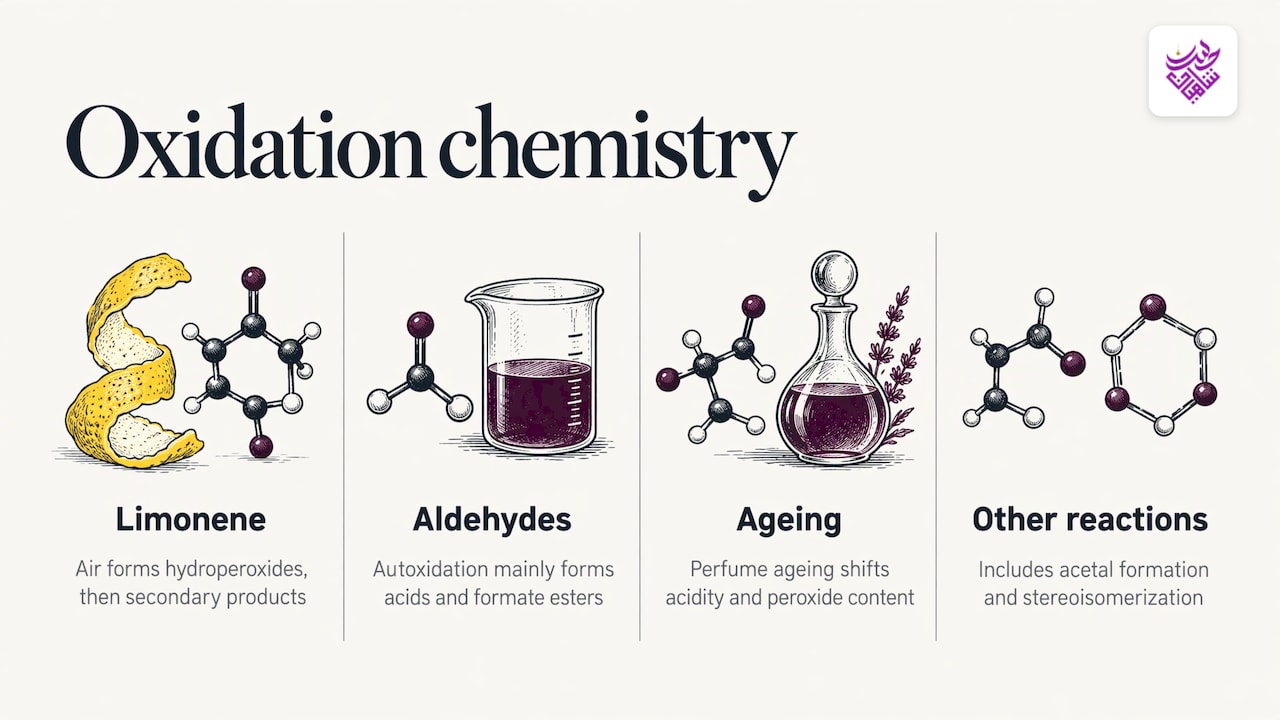
A fragrance is a composed tapestry of aromatic molecules, and many of them are chemically restless. When oxygen reaches them, some react and become different molecules with different smells. That is oxidation in its simplest form.
Take limonene, the molecule that gives citrus peel its sparkle. A 2014 study in the Flavour and Fragrance Journal describes how limonene exposed to air first forms hydroperoxides, which can then react further into secondary oxidation products. Fragrant aldehydes, the molecules that give many perfumes their luminous lift, behave similarly: research published in Tetrahedron in 2013 identifies carboxylic acids and formate esters as the main products when aldehydes autoxidize in the presence of oxygen.
The word “oxidation” is also used loosely for everything that can go wrong with an aged bottle. A classic 1987 study in the International Journal of Cosmetic Science found that perfume ageing involves several reactions at once: shifting acidity, rising peroxide content, the formation of new molecules, acetal formation and stereoisomerization. So when someone says their perfume “turned,” oxidation is usually the headline, not the whole story.
What you will notice when a bottle has turned
Your nose is the best instrument you have. Perfumers interviewed by InStyle describe sourness and a faint metallic smell as possible signs, especially in the top notes. A 2026 Byrdie feature adds that an oxidized fragrance can smell acidic or plastic-like, and that the change usually appears first in the opening, before the heart and base.
In practice, look and smell for these signals:
- The opening smells sharp, sour or like metal instead of fresh and luminous.
- The heart feels thin. The scent seems to skip its middle chapter and drop straight to a flat base.
- The color has deepened. A pale juice turning amber or brown suggests light and air have been at work. Color alone is not proof of a spoiled scent, but together with an off smell it tells a story.
- The scent no longer behaves. It fades far faster than it once did, or it smells different on your skin than it did on first purchase.
Oxidation versus maturation
Some fragrances, particularly those rich in oud, resins and amber, are enjoyed for how they soften and deepen after the bottle has rested. That is a rounding of the edges, a warmer and smoother character. Oxidation goes the other way: it brings a sour, metallic or sharp note and takes away the clarity of the top. If the change feels like a loss of brightness with an unpleasant edge, you are smelling oxidation. If the scent feels rounder and more harmonious, the bottle is simply settling.
The paper test
Before you put a doubtful fragrance on your skin, spray it on a paper blotter or a clean card and wait a minute. The perfumer quoted by InStyle recommends exactly this, and notes that oxidation products may irritate some skin types. If the paper smells right, wear it with confidence. If it smells sour or harsh, keep it off your skin.
Which notes are most vulnerable
Not every ingredient is equally delicate. Perfumers quoted by InStyle say citrus, fruit, aromatic and green top notes are especially sensitive, while woody, spicy and vanilla-rich profiles tend to be more durable. Bvlgari Parfums creative director Amandine Pallez, speaking to Byrdie, describes woods, amber and leather as comparatively stable, while reminding readers that every formula is different.
That gives a useful rule of thumb for building a collection:
| Scent family | Typical sensitivity | How to treat it |
|---|---|---|
| Citrus, bergamot, lemon, grapefruit | Higher | Keep tightly capped and cool; enjoy within a sensible window |
| Green, aromatic, herbal | Higher | Store away from light and heat |
| Fruity, floral | Moderate | Avoid warm shelves and sunny windows |
| Woody, amber, leather | Lower | Still store cool and dark |
| Vanilla, spicy, resinous, oud | Lower | Still store cool and dark |
If you love a bright citrus-and-cedar opening, that is no reason to give it up. It simply asks for a little more care. For example, a fresh citrus composition such as the Versace Fresca attar oil or the Terre d’Hermès inspired attar oil pairs citrus with cedar and vetiver, a structure that gives the brightness a woody anchor.
What speeds oxidation up
The 1987 ageing study is still the clearest guide. Its authors found that air, elevated temperature, daylight and natural products accelerated the formation of acidic reaction products, and that heat, light and air accelerated peroxide formation. Some aldehydes converted to acetals, up to 40% for certain ones, after three months at 37°C (about 99°F). That is a laboratory condition, but it is not far from a bathroom shelf in July or a bottle left on a car dashboard.
In everyday terms, four things matter most.
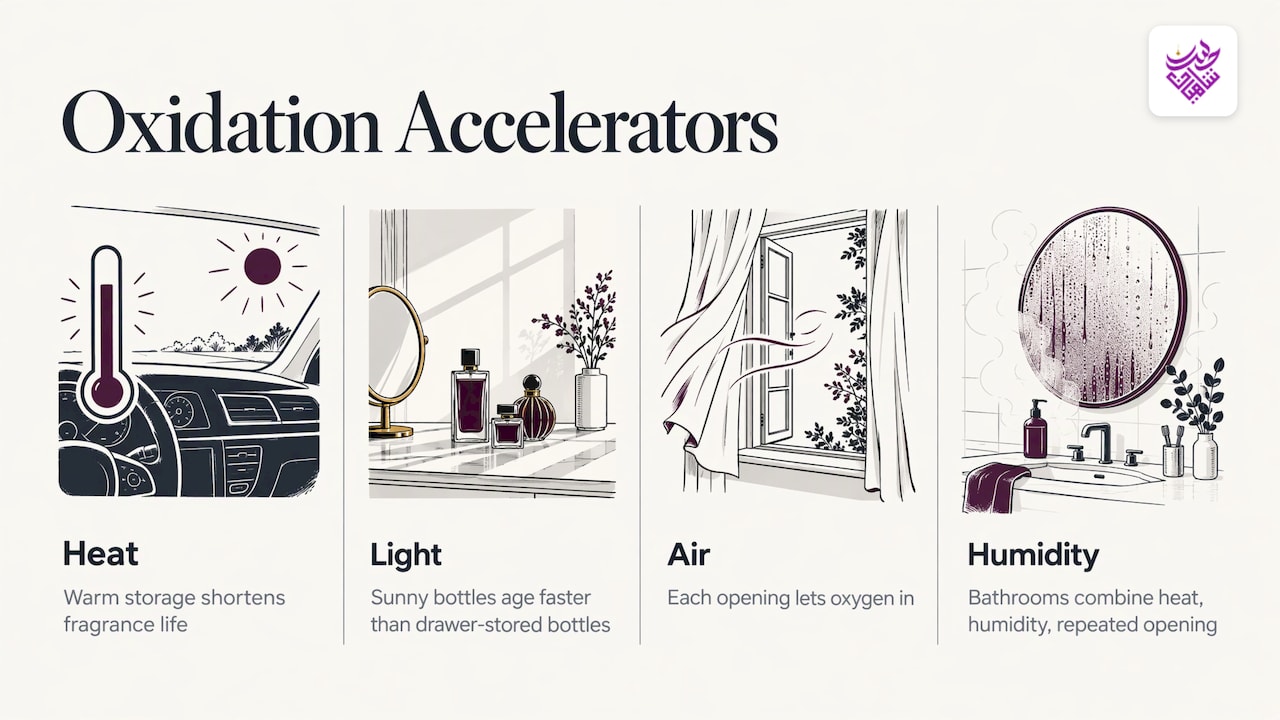
Heat. Warm storage shortens a fragrance’s life, a point the perfumers interviewed by InStyle make clearly, although there is no single lifespan for every formula. Steady, moderate temperatures are far kinder than swings from hot to cool.
Light. Daylight and UV push molecules to break down or rearrange. That is why a glass bottle on a sunny vanity ages faster than the same bottle in a drawer.
Air. Every time you open a bottle, oxygen gets in. Byrdie notes that a half-empty bottle holds more oxygen above the liquid than a nearly full one, so the last third of a bottle is its most exposed stage.
Humidity. Bathrooms combine heat, humidity and constant opening of the door and cabinet. Byrdie lists humidity among the things to limit, along with repeated decanting.
A reassuring note from the lab
Not every bottle is in danger. The 2014 limonene study cautions against assuming that results from concentrated limonene in open air apply to diluted consumer perfumes, which have their own formulations, headspace and antioxidants. In the same research, repeatedly opened, half-empty eau de toilette bottles stored for nine months showed no sign of limonene hydroperoxide formation, and aged fine-fragrance samples showed only traces of a secondary product in a minority of cases. Carefully made perfumes are more resilient than the alarming headlines suggest. Good habits simply keep that resilience intact.
How to store perfume so it stays beautiful
The advice from perfumers is consistent: cool, dark and stable. InStyle’s perfumers recommend keeping bottles away from heat and daylight, and some suggest the refrigerator for a long-term bottle. Here is a routine that is easy to keep.
- Choose a drawer or closed cabinet in a bedroom or closet. Interior rooms hold a steadier temperature than bathrooms or windowsills.
- Keep the original box if you have one. It is a ready-made light shield, and many people find it makes a tidy home for a bottle.
- Close the cap or stopper firmly every time. Less air in means less oxygen to react with.
- Spray rather than dab from open bottles. Fewer openings means less exposure; this matters most for attars and oils with a stopper or roll-on.
- Avoid unnecessary decanting. Each transfer introduces air, and a small vial with a large headspace is exposed to more oxygen relative to its contents.
- Never leave a bottle in a hot car. A parked car in summer is one of the harshest environments a fragrance can meet.
- Travel with a pouch. Keep your travel bottle out of direct sun and away from the hotel window.
The same principles apply across oil-based products. A guide on storing oils safely makes the case for keeping them capped and out of heat and light, and a piece on how to tell when products have gone bad shows how smell, color and texture changes signal that something has shifted. Both echo what perfumers say about fragrance.
Why a longer-lasting scent starts with a well-kept bottle
People sometimes mistake a fading scent for a spoiled one. A bottle that smells right on paper but disappears on skin is usually a question of skin, application and concentration rather than oxidation. We have written about this in why some fragrances last much longer than others, and it is worth a read alongside this one. Together, the two explain how to tell a fragrance that is simply gentle from one that has turned.
If your perfume has already turned
Be honest with your nose. If the scent is sour, metallic or acrid on paper, it will not recover, and wearing it risks irritation on sensitive skin. If you have any skin reaction after wearing a fragrance, wash the area and speak with a doctor or dermatologist if it persists.
If the change is mild, for instance the top notes have dulled but the heart and base still smell lovely, many people keep wearing the bottle, applying it to clothing or a scent strip in the first instance, and moving the rest of the collection to better storage. The aim is simple: protect what you have and start fresh with a bottle you will enjoy while it is at its best.
Perspective
We grew up around scent that was meant to be lived with: oud resting in a cool cabinet, bakhoor kept in a sealed tin, attars opened only for the moment they were needed. Nobody called it a storage strategy. It was simply respect for something precious.
That respect is what we bring to every bottle at HSA Perfumes. Our perfumes, attars and incense are rooted in traditional Arabian methods and ingredients sourced from the Middle East, and our collection of oud, perfume oils, alcohol-free and water-based perfumes gives you a wide range of ways to wear fragrance. The kindest thing you can do for any of them is give them a calm, dark home and a firm cap.
Think of a fragrance wardrobe as a living tapestry. The bright citrus threads want a little more care, the resinous woods and ouds ask for patience, and all of them reward you with a richer, truer scent when you treat them well.
Marjan
Choosing your next bottle with confidence
If you are replacing a bottle that has turned, or building a collection you plan to enjoy for years, our Arabian fragrance range is a graceful place to begin. Browse perfumes, attars, bukhoor, oud, mamool, water perfumes, uunsi and air fresheners in the full HSA Perfumes collections, or step into the depth of an oud such as the Byredo Oud Immortel inspired perfume oil, the Purple Oud inspired concentrated oil or the Leather Oud inspired oil.
For warm, woody compositions, the Eternal Love attar brings woody musk, sandalwood, tobacco and cedar together, while the Tom Ford Vanilla inspired blend offers citrus, vanilla and amber. If you are buying for a gift or considering a private label or wholesale project, we are glad to help you find the right direction.
FAQ
What does it mean when a perfume oxidizes?
It means oxygen has reacted with some of the fragrance molecules, creating new compounds with different smells. Heat, light and air speed the process. You may notice a sour, metallic or sharp opening, and the change usually shows first in the top notes.
How long does it take for perfume to oxidize?
There is no single answer, because every formula is different and storage matters enormously. Research shows warmth and light accelerate the reactions, while cool, dark storage slows them. A bottle kept in a drawer, tightly capped, can stay in good shape far longer than one kept on a sunny shelf.
Can you fix an oxidized perfume?
No. The molecules have changed, and the original scent cannot be restored. Test a doubtful bottle on paper first. If it smells sour or metallic, avoid wearing it on skin, and store your remaining bottles in a cooler, darker place.
Is it better to keep perfume in the fridge?
Some perfumers suggest it for long-term storage, as InStyle reports, because steady cool temperatures slow reactions. A closet or drawer in a temperate room works well for most people, as long as the bottle is dark, dry and capped.
Sources
- Stability of limonene and monitoring of a hydroperoxide in fragrance products (Flavour and Fragrance Journal, 2014)
- Chemical reactions in perfume ageing (International Journal of Cosmetic Science, 1987)
- How to Know When Your Perfume Has Expired (InStyle, 2020)
- Does Perfume Expire? Fragrance Experts Weigh In (Byrdie, 2026)
- Storing oils safely
- How to tell when products have gone bad

Comments (0)
There are no comments for this article. Be the first one to leave a message!